Palais Garnier Paris: Walking Through History and Phantom Mystique
The Palais Garnier, Paris’s most infamous opera house, exists today because of a failed assassination attempt on Emperor Napoleon III in 1858. When Italian nationalists hurled bombs at the imperial carriage outside the old opera house on the Rue Le Peletier, the Emperor survived the blast but vowed to build a new, safer venue with a secure, private entrance. An architectural competition was launched, and Charles Garnier, a then unknown 35 year old architect, won by beating out 171 entrants with his unapologetically flamboyant, eclectic Second Empire style.
Construction began in 1861, but workers immediately hit a major complication: a rising underground water table that constantly seeped into the foundations. Steam pumps operating around the clock couldn’t keep the swampy ground dry, so Garnier devised an ingenious engineering solution. Instead of fighting the water, he incorporated it into the design, building a massive concrete cistern beneath the foundation to weigh the building down and contain the moisture. Little did anyone know, this dark, hidden reservoir would later inspire Gaston Leroux to create the subterranean lair of the main character, Erik, who is the mysterious Phantom of the Opera. At a total cost of roughly 36 million gold francs, it was the most expensive building ever constructed at the time.


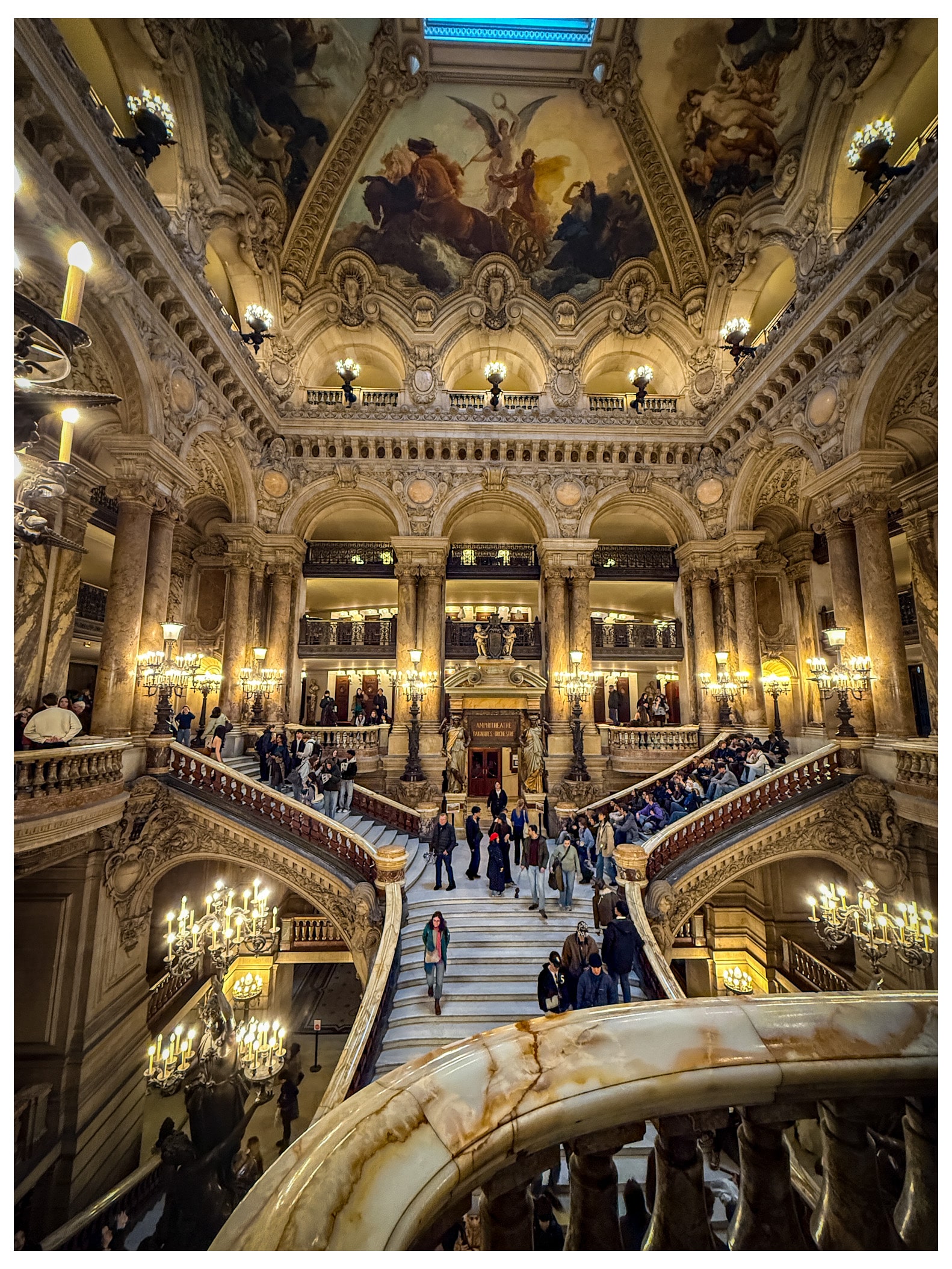
We visited this past March, with the exterior undergoing significant restoration. Between the web of scaffolding and an absolute downpour of a day, exterior photos simply weren’t happening. But stepping inside changed everything; the interior more than made up for the grey skies outside. Walking through this opera house is a lesson in humility in the face of what the imagination of one man can wrought.
We entered the building through the unique, circular Subscribers’ Rotunda, located directly beneath the main auditorium. This grand entry vestibule was explicitly designed to welcome the high society crowd who arrived by horse-drawn carriages. The entire space behaves like a beautifully calculated piece of theater. If you look up, the ceiling features an intricate web of carvings, but the real marvel is right under your feet: the floor is a massive, hypnotic layout of geometric marble mosaics.
Just past the rotunda sits the dramatic Pythia Basin, a fountain cave featuring the famous bronze statue of the Pythia, the ancient high priestess of Apollo. Sculpted by Adèle d’Affry, a trailblazing female artist working under the pseudonym Marcello, the eerie, twisting priestess was a personal favorite of Garnier’s. Moving from this lower level to welcome us at the very base of the majestic Grand Staircase are two spectacular, full size bronze female allegories known as Les Torchères. Sculpted by Albert-Ernest Carrier-Belleuse, these majestic figures hold cascading bouquets of light. Garnier intentionally designed them as a tribute to the evolution of stage lighting; look closely at their intricate headdresses and you can spot subtle symbolic references to candle lighting, gas lighting, oil lamps, and modern electricity.


From there, we ascended the legendary Grand Staircase, a spectacular 30 meter vault of multi colored marbles. The steps split into two curving flights where elite 19th-century theatergoers could see and be seen from the surrounding balconies. High above the marble balustrades, the soaring ceiling features the vibrant, grand frescoes of painter Isidore Pils, who captured sweeping scenes including the Triumph of Apollo and the allegory of the City of Paris.
Before stepping into the auditorium itself, we were drawn to the entrance of the theater loges, which is guarded by two monumental, striking stone caryatids. Sculpted by Jules-Édouard Thomas, these giant, beautifully draped female architectural pillars represent Tragedy and Comedy. One figure holds the somber dagger and weeping mask of theatrical drama, while her companion holds the joyous tambourine of comedic theater, acting as timeless gatekeepers to the performances within.
Before stepping into the main foyer, we passed through the Avant-Foyer, a long gallery lined with shimmering gold mosaics. At the opposite ends of this hallway sit two small, hidden circular anterooms known as the Salon du Soleil and the Salon de la Lune. Garnier designed them as a playful nod to day and night, heat and cold. The Salon du Soleil is dominated by warm gold tones, featuring a golden sunburst and a fire-dwelling salamander on the ceiling. The Salon de la Lune acts as its cool, silver counterpoint, painted with nocturnal bats and owls under a faux night sky. Amusingly, the decorator mixed up the plans during the final pre-opening rush, reversing the installation so that the warm sunroom mistakenly led to the cold glacier refreshments room, much to Garnier’s eternal dismay.
The architectural drama peaks inside the palatial Grand Foyer, a 154 meter long gallery designed explicitly for socializing during intermissions. Intended to mimic the breathtaking scale of the Hall of Mirrors at Versailles, the entire hall is a dizzying kaleidoscope of gold leaf, towering mirrors, and massive crystal chandeliers. The magnificent, opulent ceiling overhead was painted over the course of eight years by artist Paul Baudry, who filled the vaults with rich, classical frescoes depicting the history of music, poetry, and dance.


The high society crowd that walked these gilded halls lived by strict social rituals. Wealthy Parisians would arrive dripping in their finest high-end jewelry, rented or retrieved for the night from the legendary luxury boutiques on the neighboring Rue de la Paix and Place Vendôme. Because carrying such vast fortunes through the dark Parisian streets was incredibly dangerous, the local banks around the Place de l’Opéra actually adjusted their operating schedules, keeping their high-security safety deposit vaults open deep into the night so opera-goers could safely return their diamonds immediately after the final curtain closed.
For fans of Leroux’s 1910 novel, the building still feels like walking through a Gothic mystery. Beyond the hidden underground lake, which still sits beneath the stage as a structural water reserve used by the Paris fire brigade, the auditorium hides the Phantom’s most famous demands. If you look toward the first tier of boxes on the left side of the grand auditorium, you can spot Box 5. The door features a brass plaque officially declaring it the Loge du Fantôme de l’Opéra, immortalizing the very box Erik claimed as his own.
Look straight up from the velvet seats and you’ll see the sweeping ceiling dome painted by Marc Chagall alongside the massive bronze and crystal chandelier. On May 20, 1896, a heavy counterweight from this very chandelier broke loose during a performance, crashing through the ceiling and killing a spectator named Mme. Chomette, who ironically worked as the building’s concierge. The Parisian newspapers ran with the sensationalized headline, “Two Hundred Kilos on the Head of a Concierge!”, a real life tragic accident that Leroux copied directly into his novel to inspire the famous chandelier climax.
The roaring success of this building propelled Garnier to legendary status. He went on to design the lavish Opéra de Monte Carlo and Casino in Monaco, the circular Théâtre Marigny in Paris, the luxury Casino and Thermal Baths at Vittel, and even the intricate tomb of composer Jacques Offenbach in the Montmartre Cemetery. He also collaborated with Gustave Eiffel on the Nice Astronomical Observatory, with Garnier designing the classical base and Eiffel engineering the floating metal dome.
If you are planning your own pilgrimage to this temple of music, timing is everything. The historic opera house is preparing for an extensive, €450 million modernization and restoration project. The main stage and auditorium will close entirely from the summer of 2027 until 2032 to overhaul aging stage machinery and complete critical lead decontamination work. While performances will stop entirely, public tours of the Grand Foyer and Grand Staircase are expected to continue, though they may face temporary closures of up to two years if construction disruptions become too severe.
Tickets for tours can be purchased through the opera house‘s official website. Multi media iPads with audio and video guides are available for the self guided options. The entry fee is €25 per person, plus an extra €8 per person for the multimedia accompaniment. You