May 16, 2025 – Crossing Borders: Our Day Trip to Počitelj, Mostar, and Blagaj
🚗 Day Trip to Bosnia & Herzegovina: Počitelj, Mostar, and Blagaj
Our morning began at sunrise as we made our way outside the walls at Buža Gate to meet our private driver for the day. We were heading back into Bosnia & Herzegovina to see the famous Mostar Bridge, with a stop along the way in the little town of Počitelj. Our driver, Rada Zaric, is not only a guide but also a talented artist and jeweler. (If you’re curious, check out her Etsy shop at StudioDaaR. Her clay polymer jewelry is really well done!)
The drive from Dubrovnik to Mostar takes just under two and a half hours, with a border crossing along the way. We had read plenty online about potential long waits at the border, so we opted for an early start, hoping to breeze through before traffic built up. Luckily, our timing was perfect and we were across in no time.
Počitelj
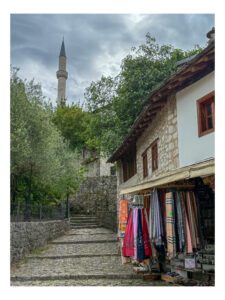
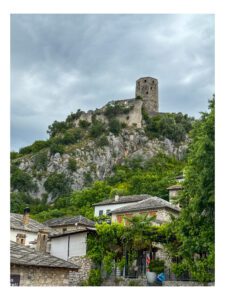
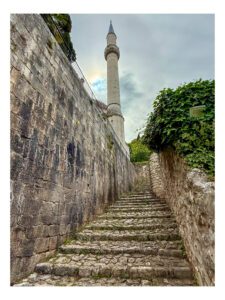
Our first stop was the village of Počitelj, about 30 kilometers south of Mostar. Founded in the 14th century by Bosnian king Tvrtko Kotromanić, Počitelj has always been of strategic importance thanks to its perch above the Neretva River. The Ottomans left a strong architectural imprint here, with mosques, fortresses, and stone houses that still stand. Although much of the town was damaged during the Bosnian War in the 1990s, restoration has brought back its medieval charm, and slowly residents are returning.
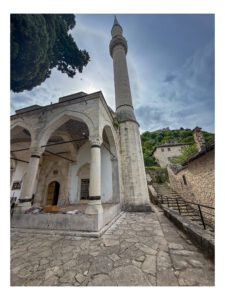
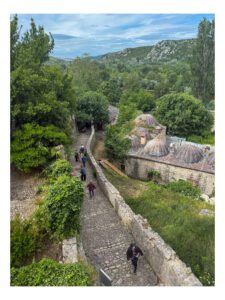
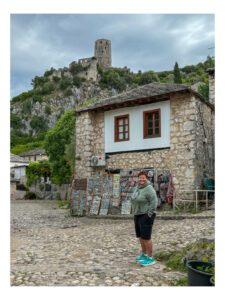
The fortress, originally captured by the Ottomans in 1471, still dominates the hilltop, and the small domed mosque is considered one of the finest of its kind in Bosnia. Počitelj is one of the best preserved walled towns in the country and was even placed on the World Monuments Watch list in 1996. Wandering its cobblestoned lanes and climbing up for sweeping views was like stepping back through the centuries.
Mostar and Stari Most
Back in the car, we continued to Mostar, famous for its iconic Stari Most, or Old Bridge.
🏛️ History Spotlight: Stari Most
The bridge was originally commissioned by Ottoman Sultan Suleiman the Magnificent and completed in 1566. At the time, it was considered an architectural marvel, a single stone arch stretching almost 30 meters across the Neretva River. For centuries it symbolized connection and unity between cultures. Tragically, it was destroyed during the Bosnian War in 1993, but thanks to UNESCO and international efforts, it was meticulously rebuilt using traditional techniques and reopened in 2004. Today, it is once again a proud emblem of resilience and reconciliation.
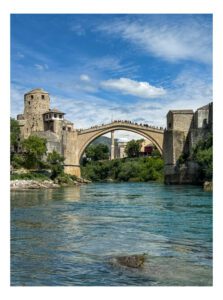
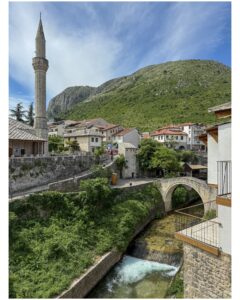
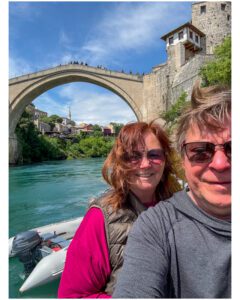
When we arrived, the bridge was absolutely packed. We managed the requisite selfies and then slipped down to the riverbank for another view. Ron and Tami quickly decided a cold beer at a nearby bar was the better choice, while I wasn’t satisfied with my crowded photos and went searching for a better angle.
This led me, somewhat foolishly, to follow a tiny path down to the riverbank, where I scrambled across slippery rocks for a perfect mid-river shot. It worked, but let’s just say I wouldn’t recommend it. One misstep and I could have been swimming with my IPhone. Looking at the photo now makes me cringe as much as it makes me smile.
Once I returned safely, I joined Ron and Tami for a much-needed cold beer under the hot Bosnian sun. The town itself is charming, but the crowds were heavy and I can only imagine how overwhelming it must be in peak summer. I admit I’m torn on whether I’d recommend Mostar as a day trip; worth seeing, yes, but perhaps not essential if time is limited.
Lunch and Blagaj Monastery
For lunch, we hit up Food House, a traditional Bosnian restaurant. We shared their homestyle platter, which included Japrak (stuffed vine leaves), Dolma (stuffed vegetables), and creamy potato mash. Paired with salads and another round of beers, it was hearty, flavourful, and the perfect break from the heat.
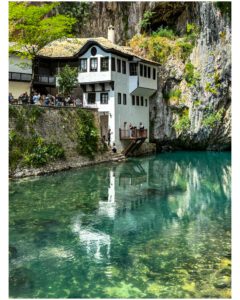
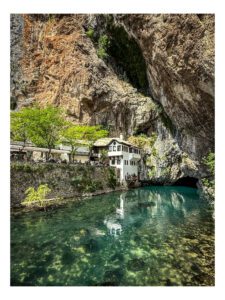
Our final stop before heading back to Dubrovnik was the Blagaj Tekija Monastery, one of the most peaceful places I’ve ever been. Built in 1520 by Dervish monks, a mystical branch of Sufi Islam, the monastery sits dramatically at the base of a cliff beside the crystal-blue Buna River. Known as a tekija, a place of spiritual retreat, it’s still considered a place for reflection and prayer. The setting is unforgettable: white stone walls pressed against the rock face, the sound of rushing water, and the serenity of the surrounding village. Even for those who are not religious, it is an atmosphere that invites calm.
Back in Dubrovnik
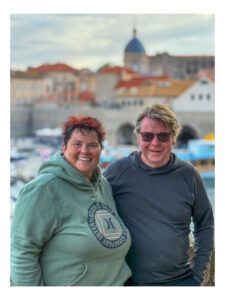
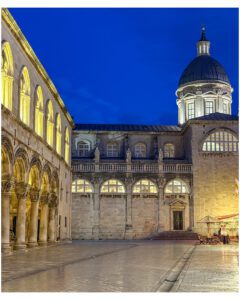
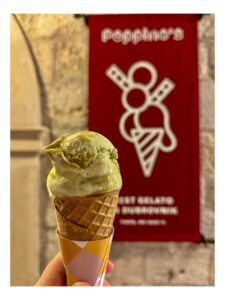
We rolled back into Dubrovnik tired but grateful. Dinner was an easy pizza stop, though nothing topped our earlier find at Pizzeria Mirakul, followed by one last gelato from Peppino’s Gelato Factory. Back on our deck, feet up with wine in hand, we soaked in our final Dubrovnik night. Tomorrow we would be off to discover neighboring Montenegro, but for now we simply sat back and savoured the memories.