May 20, 2025 – Exploring the Bay of Kotor: Serpentine Road, Perast, and Our Lady of the Rocks
Of Altitudes and Altars
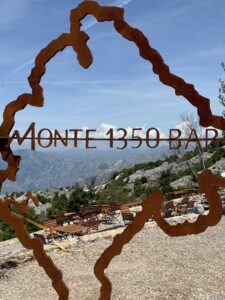
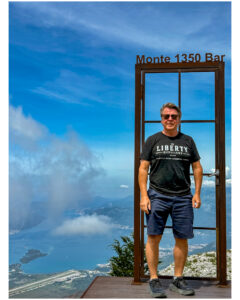
We left Budva that morning and drove inland through Obzovica, winding our way up toward the old royal capital of Cetinje with the Bay of Kotor as our ultimate destination. The landscape shifted from coastal olive groves to rugged mountain terrain as we climbed higher. But our destination wasn’t the capital itself. We kept going, up past Cetinje, until we reached the 1350 bar perched at the crest of the mountain.
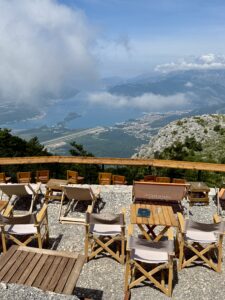
At 1,350 meters above the bay, the view was dizzying. We ordered coffees and stood on the terrace watching tiny boats crawl across the water far below. The islands of Our Lady of the Rocks and St. George were just pale dots on the deep blue canvas. We were looking down at where we’d end up hours later.
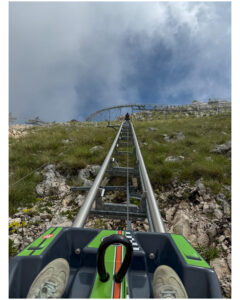
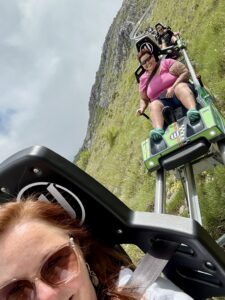
Right beside the bar, we spotted the “sitting roller coaster,” a gravity cart track that sends riders hurtling down the mountainside. We couldn’t resist. With a handbrake for speed control and a track full of fast corners and thrilling hills, it was the perfect burst of adrenaline. We raced down with the bay rushing toward us, laughing like kids, the wind whipping past as the view grew bigger with every drop.
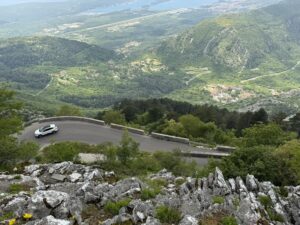
After that rush, we got back in the car and began the descent. The legendary Kotor Serpentine Road snakes down from the mountains toward the coast. Built between 1878 and 1884 by the Austro-Hungarian Empire, this engineering marvel was designed by Josip Slade to connect the interior with the port. Local legend says he shaped its famous 25 hairpin bends into an “M” as a secret tribute to the woman he loved. The drive is an adventure, a winding ribbon of asphalt that clings to the mountainside, rewarding every nerve-wracking turn with a view so vast it makes your breath catch.
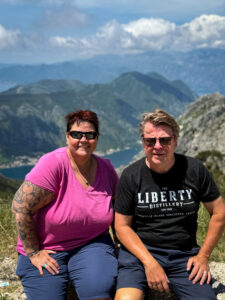
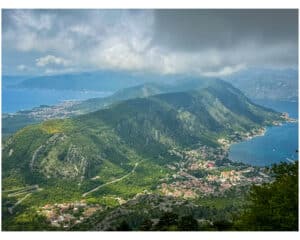
By the time we reached the bottom, our stomachs reminded us of more earthly needs. We’d heard whispers of a mountain restaurant with legendary soup but hadn’t booked ahead. We pulled into Njeguši and found Kafana Kod Pera Na Bukovicu, a rustic, family-run spot perched high above the bay. We lucked out. Despite the crowd of fellow travelers who clearly knew the secret, a small table was waiting. We ordered the famous soup, a hearty, soul-warming bowl that tasted even better with the cool mountain air and the panoramic view stretching all the way back to the water we’d just descended.
Fueled up and ready, we made our way to the waterfront, parked the car, and stepped into the timeless stone streets of Perast.
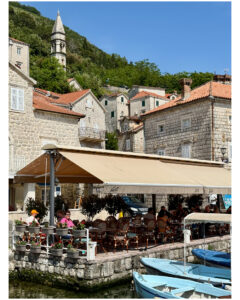
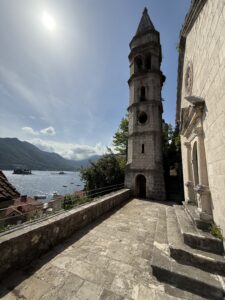
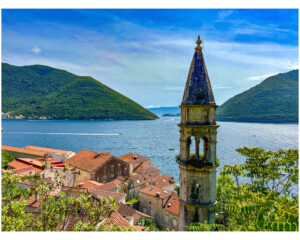
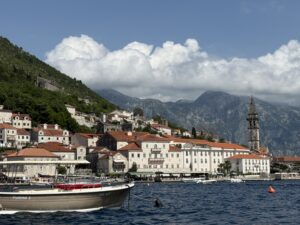
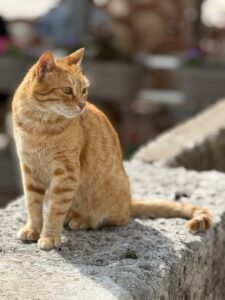
We spent the next hour crawling all over the hills of Perast, wandering up narrow stair-streets and through sun-dappled alleyways that seemed to lead nowhere and everywhere at once. Every turn revealed another steeple piercing the blue sky. The town has sixteen churches, each one a quiet masterpiece of baroque stone. And the cats. They were everywhere, lounging on ancient walls, padding across worn cobblestones, posing for photos like they knew exactly how photogenic they were. We must have snapped a hundred pictures between the steeples and the felines, losing all track of time.
Eventually we made our way back to the waterfront, where we spotted a local guide with a small wooden boat bobbing at the dock. We struck up a conversation and within minutes had arranged a ride across the bay. As we climbed aboard and pushed off from Perast’s shore and into the Bay of Kotor, the town’s grand palaces and church domes slowly receded behind us. The small, church-topped islet ahead grew larger with every stroke of the oars. Our guide smiled and began to tell us the story.
The legend begins on July 22, 1452. Two brothers from Perast were returning from a fishing trip when one of them, a cripple, spotted an icon of the Madonna and Child resting on a tiny, jagged rock jutting out of the water. He took the icon home, but the next morning it had vanished, only to reappear on the same rock in the bay. And in what the townspeople took as a divine sign, the crippled brother had been healed overnight. The message was clear. The Virgin Mary wanted a shrine built on that exact spot.
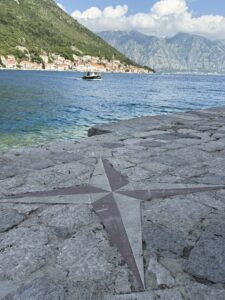
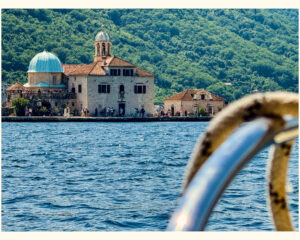
There was just one problem. There was no land. So the people of Perast began sinking old ships filled with rocks and piling stones onto the reef, a tradition that continued for nearly 200 years. Every time a sailor returned from a successful voyage, he added a rock to the growing foundation. Gradually, an artificial island emerged from the sea. The church was finally completed in 1630, and the building we see today dates from a renovation in 1722.
The tradition lives on. Every year on July 22, the people of Perast celebrate Fašinada. They row out into the Bay of Kotor to the island at sunset and throw rocks into the sea to reinforce its foundations against erosion.
We stepped off the boat onto the tiny island. Our guide gestured toward the stone steps. “You can walk around the outside for free,” he said, “but it costs three euros to go inside, and trust me, you’ll want to.”
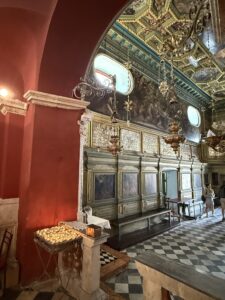
We handed over the cash and stepped through the doorway. The interior was far more magnificent than the modest exterior suggested. The walls and ceiling were covered in 68 oil paintings by Tripo Kokolja, a 17th-century baroque artist from Perast known as the local Michelangelo. Upstairs, a small museum holds over 2,500 silver votive tablets donated by grateful sailors over the centuries.
But the most moving piece was a tapestry embroidered by Jacinta Kunić-Mijović. She spent 25 years working on it, weaving gold and silver threads, and even strands of her own hair, into the fabric while waiting for her sailor love to return from a long voyage. Legend says she went blind making it and never saw him again. It’s called “Love and Faith,” and standing before it, you can feel every one of those 25 years in the intricate stitching.
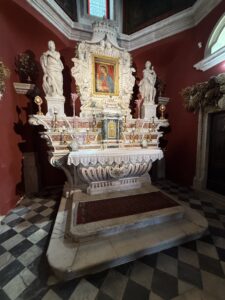
I managed a couple of photos of the altar and the immediate interior before I gave up trying to capture it all. Some places are better experienced through your own eyes. The weight of that tapestry, the quiet of the chapel, the waves lapping at the stone foundation below. Those don’t translate through a lens anyway.
We ended the day driving back along the coast to Budva, the sunset painting the bay in shades of orange and pink. It had been a day of highs and lows, of altitude and altars, of fast corners and quiet chapels. And somewhere between the roller coaster and the tapestry, we realized Montenegro had gotten under our skin.