
April 14, 2025 – Sarajevo, Bosnia-Hercegovinia
Sarajevo: Where History Breathes, Cultures Collide, and Coffee Tells Stories
Early to bed meant early to rise, and we rolled out of our little hotel room in Hotel Old Town just in time to catch the quiet morning hum of Sarajevo. After fueling up with a hearty (and delicious) hotel breakfast, we were out the door, enjoying the best part of early travel: tourist spots without the tourists.
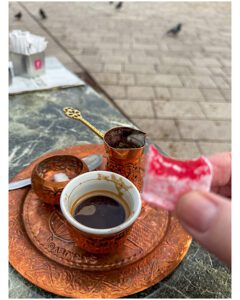
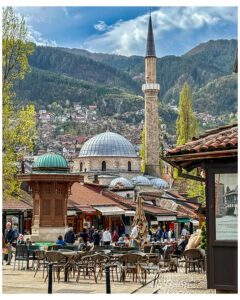
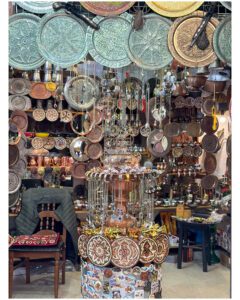
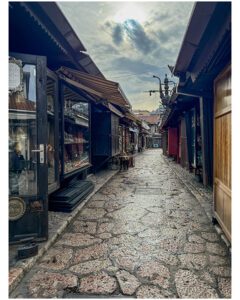
We wandered once more into the Baščaršija, Sarajevo’s 15th-century Ottoman bazaar, where time seems to slow. The alleyways were still waking up, smoke curling from grills, and locals were already sipping the first of many Bosnian coffees from tiny cups. We joined them, taking a seat at one of the low tables to enjoy our strong, thick coffee while we waited for our Walking Tour of Old Town Sarajevo to begin.
Layers of Empire and Memory
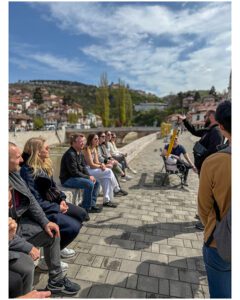
Our guide, Adis, greeted us across from the main square, just steps from the Sebilj Fountain. Instantly, we knew we were in good hands. He had that rare mix of knowledge and warmth—explaining centuries of history with the ease of a friend over drinks. As we walked through the bazaar’s maze-like alleys, he wove the tale of Sarajevo, a city shaped by empires.
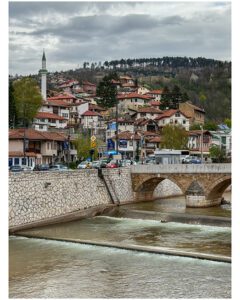
Originally founded by the Ottomans in the 15th century, Sarajevo became a melting pot of cultures—Islamic, Orthodox Christian, Catholic, Jewish—all living side by side. The result is a city that feels uniquely itself, with Ottoman courtyards flowing seamlessly into Austro-Hungarian facades, and centuries of stories carved into every stone.
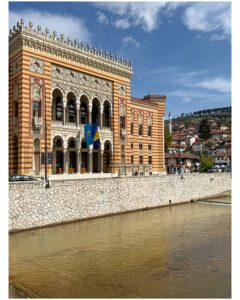
From the main square, we took a short walk east toward one of Sarajevo’s most striking buildings—the Vijećnica, or Sarajevo Town Hall. It’s hard to miss. An architectural jewel at the edge of the Old Town, Vijećnica is an opulent blend of Moorish Revival design, built during the Austro-Hungarian period and completed in 1896. Originally serving as the city’s town hall, it was later transformed into the National Library.
But its beauty hides a tragic chapter: during the Siege of Sarajevo in 1992, the building was shelled by Bosnian Serb forces, and nearly 2 million books and manuscripts were lost to the flames. Today, after a painstaking reconstruction, it stands proud again—its golden arches, stained glass, and ornate interiors once more open to visitors, both a cultural monument and a symbol of Sarajevo’s resilience. It’s one of those places where architecture, history, and memory converge in a single breath.
Of Bombs, Bridges, and a Bullet That Shook the World
We made our way back across the Miljacka River, which splits the city in two and has borne witness to more history than some nations. Here, Adis shared the story of Gavrilo Princip, a name etched into 20th-century history. Princip, a Bosnian Serb, was just 19 years old and part of a nationalist group called Young Bosnia, secretly supported by the Black Hand, a shadowy Serbian military society. Their goal: to strike a blow against Austro-Hungarian rule and spark independence for Slavic peoples.
On June 28, 1914, Archduke Franz Ferdinand and his wife, Sophie, were visiting Sarajevo. A failed grenade attack earlier in the day left one of their men injured, and in an unscheduled detour to check on him at the hospital, their driver made a wrong turn. As fate would have it, they rolled right past a stunned Gavrilo Princip—who had stopped near the Latin Bridge to regroup after the botched plan. Seizing the moment, he stepped forward and fired two fatal shots. The world would never be the same.
Today, you’ll find a modest plaque and bronze footprints marking the spot where Princip stood. No pomp. Just stillness.
Faith, Fire, and Sarajevo Roses
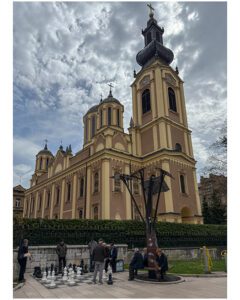
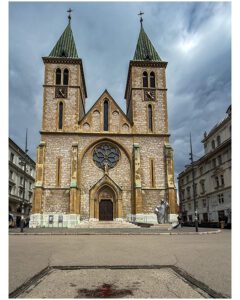
From the river, we continued to the Old Orthodox Church—one of the oldest in Sarajevo, with foundations dating back to the 16th century. Its thick stone walls hold centuries of Orthodox Christian tradition, its icons and incense a quiet counterpoint to the muezzin’s call nearby. Just a few blocks away stands the Sacred Heart Cathedral, a striking Neo-Gothic structure completed in 1889 and the largest Catholic cathedral in Bosnia. Sarajevo’s skyline isn’t dominated by one belief—it’s shaped by many.
In front of the cathedral, Adis pointed out a Sarajevo Rose. These are not flowers, but solemn reminders—shell craters left during the siege of the city in the 1990s, filled in with red resin. Each one marks the place where at least three people died in a single shelling. At the height of the war, over 300 shells fell on the city each day. You don’t just walk over these roses—you feel them.
East Meets West—In a Single Step
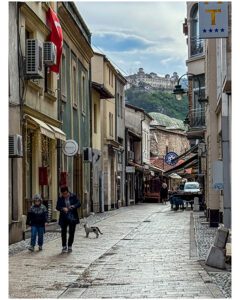
We turned onto Ferhadija Street, Sarajevo’s main pedestrian artery, and came to the literal marker where East Meets West. It’s just a simple line on the ground, but the symbolism is powerful: on one side, Ottoman-style shops, mosques, and cobblestones; on the other, Austro-Hungarian buildings with wrought iron balconies and ornate facades. You can see, in a single glance, how this city embodies the push and pull of empire and identity.
The Gazi Husrev-Beg Legacy
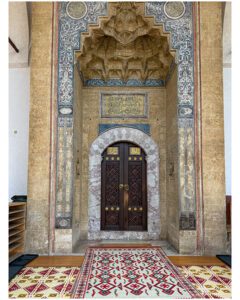
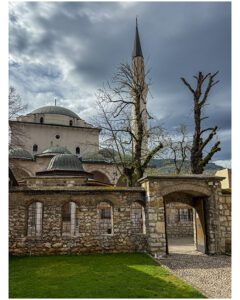
A few streets later, we stood before the Gazi Husrev-beg Mosque, the most important Islamic structure in Bosnia, commissioned in 1530 by the Ottoman governor it’s named after. Gazi Husrev-beg was more than a military man—he was a philanthropist, a builder, a visionary. His endowments include schools, libraries, and even a soup kitchen still operating today. The nearby clocktower, uniquely, follows lunar time—a tradition rarely preserved outside of Mecca.
So, What Exactly Is a Lunar Clock?
Unlike standard clocks that follow the solar day (24 hours based on the Earth’s rotation relative to the sun), a lunar clock is set according to the lunar time system—which divides the day based on the position of the sun in the sky relative to prayer times in Islamic tradition, rather than fixed hours.
In the case of the famous Sarajevo lunar clock tower, it’s one of the very few in the world still in operation. This clock is adjusted by hand to mark the time of Maghrib (sunset prayer), which in Islamic tradition is the start of a new day. That means the clock actually hits 12:00 at sunset—not at midnight like we’re used to.
Since sunset time shifts slightly each day, the clock has to be manually recalibrated every few days by a local timekeeper, just as it has been for centuries. It’s a beautiful blend of science, tradition, and faith—an echo from a time when daily life was guided not by machines, but by the movement of the heavens.
From the City to the Sky—The Yellow Fortress
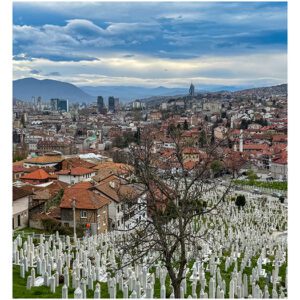
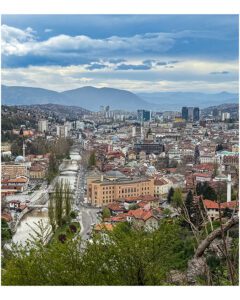
Tour wrapped, minds spinning with centuries of culture, we decided to climb up to the Yellow Fortress, an 18th-century structure originally built to defend the city during Ottoman times. The walk is steep—really steep—and not for the faint of heart (or knee). But it’s lined with white gravestones from the war, a cemetery nestled beside everyday homes. Life and death live side by side here.
At the top, the reward is staggering. The city stretches below, red rooftops and slender minarets fading into the hills. It’s one of the best views in Sarajevo, and perhaps the most emotionally charged. If walking’s not your thing, definitely consider a cab—but don’t skip it. This view tells a story words can’t.
Burek and Bosnian Wine to Close the Day
After hiking back down, hunger won out. Adis had mentioned a local spot known for its burek—a flaky pastry filled with meat or cheese—and we followed his recommendation without hesitation. It was exactly what we needed: simple, satisfying, and pure comfort food.
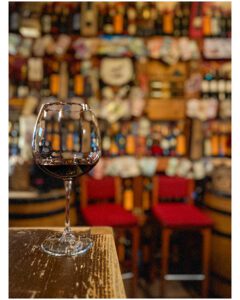
We capped off the night back at La Cava, the cozy bar next to our room at Hotel Old Town. Warm lighting, friendly staff, and a bottle of local Trnjak wine—earthy, bold, and totally unfamiliar to us, but immediately loved. We toasted to a day full of discovery, to stories that live in the stones, and to Sarajevo—a city that wears its heart and history on its sleeve.
Another unforgettable day in the books.

🧭 Exploring Sarajevo with Viator – If you’re the kind of traveler who feels more at ease with a plan in place, Viator is a great place to start. They offer a wide range of tours that take the guesswork out of exploring a new city — from guided walks to full-day excursions and everything in between. It’s a great option if you’d rather leave the organizing to someone else and just focus on enjoying the experience. We’ve used them often and love how easy they make it to discover the highlights without the stress.