
🇲🇹 Malta: Golden Citadels & Sapphire Coves
The blazing Mediterranean sun reflecting off massive, honey-toned limestone ramparts completely commands your focus the moment you land in Malta. Anchored in the literal center of the sea, this pocket-sized archipelago operates as a living, open-air time capsule. It is a striking canvas where dramatic, sheer coastal cliffs drop vertically into blindingly blue lagoons, and where prehistoric megalithic temples—monuments that are entirely pre-biblical and stand older than the Egyptian Pyramids—remain rooted against the sea breeze. Malta doesn’t just display its heritage; it wraps you inside a massive fortress landscape that has been fortified, traded, and fiercely defended by a relentless tidal wave of empires.
Our Maltese notebooks are written from the edge of historic city walls, the shade of vibrant wooden balconies, and hidden coastal caves. This is a space engineered for deep, deliberate exploration—where you can lose yourself inside the perfectly grid-aligned, Baroque alleys of Valletta, wander the silent, aristocratic stone corridors of Mdina, or hop a local ferry to explore the sleepy, rural fishing villages and cliffside hiking paths of Gozo. Malta invites you to leave the standard mainland routes behind, stand before some of the oldest free-standing ruins on earth, and experience a brilliant blend of North African warmth and European soul.
🇲🇹 Scrapbook Notes on Malta
- Population – Around 535,000 people (making it one of the most densely populated yet completely charming island nations on earth).
- Global Tourism Ranking – Securely holding the #58 spot in the world for international arrivals. The archipelago welcomes roughly 3 million visitors annually, though the vast majority remain strictly along the standard northern resort beaches.
- Capital City – Valletta – A masterpiece of Baroque military architecture, built entirely from golden limestone blocks by the Knights of St. John on a narrow peninsula, where incredibly steep streets frame dramatic ocean views at every turn.
- Most Visited Hubs – The silent, aristocratic stone corridors of Mdina; the blindingly clear turquoise waters of the Blue Lagoon on Comino; and the sleepy, rural sister island of Gozo.
🇲🇹 Hidden Gems You Should Seek Out
The Historic Maritime Streets of Birgu – The absolute oldest of the iconic “Three Cities” sitting directly across the Grand Harbour from Valletta. Leaving the main capital capital lines behind to wander the narrow, car-free limestone alleys of this quiet maritime town brings you past historic knight palazzos, hidden shrines, and beautiful flower-draped stone steps that offer the ultimate authentic Maltese neighborhood escape.
The Siege Bell War Memorial and Tower – A striking, neoclassical pillared dome sitting proudly on the absolute outer edge of Valletta’s rocky defensive bastions. Built to honour the incredible resilience of the islands during the heavy air raids of World War II, standing beneath this massive bronze bell offers a profound, windswept moment of reflection right over the deep sapphire entrance of the Grand Harbour.
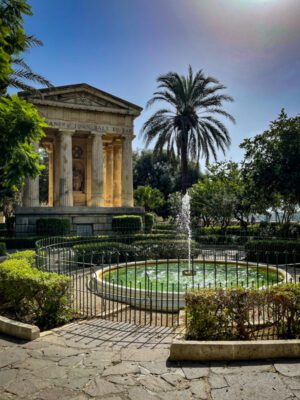
The Upper and Lower Barrakka Gardens – A pair of breathtaking, green-colonnaded garden terraces perched high on the ancient stone ramparts of the capital. While the Upper gardens offer a sweeping, jaw-dropping panoramic look at the noon-day cannons firing over the Grand Harbour, walking down to the quieter Lower gardens reveals a perfectly manicured, temple-like neoclassical pavilion where you can escape the mid-day heat in complete stillness.
🇲🇹 Know Before You Go: Malta Basics
- Language: Maltese and English. Because Malta was a British colony until the late 20th century, English is an official language spoken with absolute fluency by virtually everyone on the islands. It makes tracking down hidden local gems incredibly easy!
- Currency: Euro (€). Unlike many other cash-centric Mediterranean tracks, Malta is highly card-friendly. You can easily tap your phone or card at almost all major restaurants, hotels, and boutiques. However, keep around €20 in physical cash handy for smaller beach kiosks, local harbour water-taxis, and traditional market stalls.
- Best Time to Visit: To catch spectacular daylight hours and comfortable exploring weather without the scorching mid-summer heat or heavy summer tourist crowds, aim for April to May (Spring) or September to October (Autumn).
- Getting Around: Because of its British colonial heritage, traffic in Malta moves on the left side of the road. If driving on the left feels too intimidating, the island features a brilliant, cheap public bus network operated by Malta Public Transport that reaches almost every corner of the main islands. Pick up an unlimited Tallinja Card right at the airport terminal to tap onto the buses effortlessly!